Showing posts with label Done. Show all posts

Thursday, 3 January 2013

Plot Summary - James and the Giant Peach


Plot

Dahl wrote it in 1961, and centers around a young (seven to be precise) English boy who, having lost his parents in a freak accident involving a rhino, goes to live with his cruel Aunts Sponge and Spiker. He is regularly beaten, and appears to be kept in almost slave like mistreatment.
James meets a strange and unexplained magical old man, who seems to know James plight. The old man gives James a bag of "1000 slimy crocodile tongues" which possess magical properties. James is told to keep them safe, but being in a rush to get back to his home he drops the bag right under an old peach tree.
By the next morning, James Aunt's discover that not only has the previously fruitless tree produced a peach, but the peach wont stop growing! They quickly monopolize the peach, and the paying public come to view the peach.
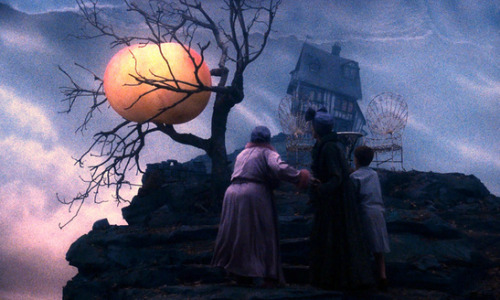
Meanwhile, James appears not to have returned home, but instead climbs inside the now enormous Peach through a mysterious passage right into the Peach stone. Once there he meets a Grasshopper, Centipede, Spider, Ladybird, Glowworm and Silkworm. All these insects have become enormous and appear to have been given human intellect and power of speech from the magical crocodile tongues James dropped the previous night. The Insects and James cut the giant peach loose and roll down the steep slope from the Aunts house to the sea.  Meanwhile, both aunts get squished. Yay!
James is introduced to all the inhabitants, and quickly learns that the insects are far kinder than any humans James had met since his parents died.
Sadly, sharks approach the peach, so James decides to attach the Spiders and Silkworms threads to the necks of seagulls and flies the peach onwards!

Whilst airbourne, the Peach strays into some clouds. In these clouds, the crew of the Peach discover sinister creatures James calls "Cloudmen", who create all sorts of scary meteorological phenomina which the throw down to Earth. James and the crew are pelted with hail stones, but the seagulls drag the peach onwards through the Cloudmen city and right across the Atlantic.
James realises that the peach has been transported all the way to America. The crew all celebrate, but quickly realise the strings attached to the seagulls necks have been slashed by a passing airplane. The peach hurtles downwards, and the all the inhabitants of the Peach believe they are going to die. Luckly though, the Peach lands right atop a building.


The Empire State Building! The crew are brought down and presented to the Mayor of New York, who welcomes them with open arms. All the inhabitants find new jobs, and James lives happily ever after inside the Peach stone, where it has been placed in Central Park. It is revealed that James has in fact written the very story the reader has read.

Reception

Because of the books scary and macabre images it is  "a regular target of the censors and is No. 56 on the American Library Association's top 100 list of most frequently challenged books" (1)
This is not without reason, and as a company we must remember that our audience is potentially quite young. Some of the aspects which I believe may need to be tackled carefully are as follows:

  • The Rhino eats James' parents  - An utterly terrifying idea even to an adult
  • The Aunts - James is frequently beaten, verbally abused, overworked and rarely fed. This could be very upsetting to children who will identify with James as he is a young child too. The Aunts are also potentially  fear inducing, as they are grotesque and self indulgent to an extreme. This should be treated carefully, and to diffuse the fear factor make them comical not fearful. Personally I think this is one of the problems with the film.
  • The Cloudmen - Scary weather controlling people in the sky - Whats not to be afraid of? To make them less scary, they should be magical rather than scary, and perhaps even comedic?
  • The Peach freefalling - this is deadly situation, but hopefully the funny responses of the characters will make it less scary and its short period 


Sunday, 30 December 2012

The Narrator - A Character Study

The Oxford English Dictionary defines narrator as: 
"a person who narrates something, especially a character who recounts the events of a novel or narrative poem" (1)
The term 'Narrator' comes from the Latin word narrre meaning 'Knowing'(2). This seems to me to a be a highly reasonable explanation for what a narrator does, they know all (supposedly) and are willing to share their knowledge (normally). 
There are different types of narrators (3), such as the:


  • Unreliable narrator e.g. Patrick Bateman in American Psycho or Briony Tallis in Atonement. A narrator who delibratly or mistakenly retells the story in a distorted or untrue fashion, often with a selfish motive.
  • The Secret Character e.g. Lemony in A series of Unfortunate Events. A narrator who only pretends to be detached from the story, who is later revealed as a character, and can often be used to great dramatic effect.
  • The Detached Observer  e.g. George Orwell's 1984. The narrator never inserts their own point of view or uses "I" or "Me". 
  • The Commentator e.g. A Christmas Carol by Charles Dickens. The narrator who never physically enters the story, but give insight and amusing commentary. This is the type of narrator I believe is in James and the Giant Peach. However the book differs from the adapted play, in that in the book it is revealed that James himself has written the book so James is actually the narrator to his own story. However, this device is not used within the play, and the part of narrator is a separate character. In our adaption we have split the part of narrator into three (as their was a huge amount of speech to learn and it makes the narrator a more interesting device).
Childrens Theatre Narrator 
As to specific techniques for a Narrator I have not been able to find much in the way of websites or books. However, I would assume the following were important:
  • Clear diction - The narrator is the thread throughout the play and if the audience cant understand what you are saying they may miss important bits of information. Also, we are performing for school children its important we encourage clear speaking for learning.
  • Energy - We are performing for children, kids like energy and not childish behaviour. 
  • Ability to interact with children in a enthusiastic manner
  • Ability to recognize the children's conceptual age - what can the children easily understand

Roald Dahl


Roald Dahl is an English writer, poet and screenwriter. He is best known for his childrens books including Matilda, The BFG and James and the Giant Peach. He was born in 1916 in Wales, and spent much of his childhood at a boarding school. He had a miserable time whilst at the two schools, he was very homesick and was frequently caned.
These terrible circumstances may have lead him to create characters, such as James Trotter, who suffer awfully at a young age by vicious adults, such as Aunt Spiker and Aunt Sponge, the Witches or Matilda's parents. Where the young Roald felt like he had no power over his circumstances, the protagonists of his books always overcome their abusers and triumph in the end.

Saturday, 29 December 2012

Childrens Theatre

source: sys images
Some things the class has noted as important whilst doing a performance for children, i.e. what a children's theatre actor needs to do (comments in brackets represent how to develop this):
  • Children are smart, especially when it comes to sussing' out adults. So, its very important to remember the show is for the audience, not to make ourselves look good. its also important not patronize the kids. (A video recording of our performances might help us to realize how we look from an audiences perspective.)
  • Remember that this trip to a show might be the first time the children have ever been in a theatre, and so our performance may influence their future interest in drama. No pressure! (Make every performance we do as fresh as possible, as this will make it more engaging. This can be very hard when you're tired!)
  • Children get bored. Easily. This doesn't not mean that the children's shows has to be constant fun and jokes, but it does mean that the actors must be able to 'read' their audiences reactions, and be willing to change according to each audiences needs.
  • Children enjoy interaction with the play, so not all noise and wiggling means the children are bored, quite the opposite! As a narrator, I can much more interact with the children and their reactions than the members on the peach could. Actively asking the children what they think and responding could be very effective story-telling technique. 
  • Its also important to remember not all kids are the same. Some will be quite happy to sit quietly and listen and won't enjoy interaction, whilst others will be bouncing around. If the audience is quiet, the actor should not (always) consider this as a bad thing. (When not talking, I can study the childrens faces and reactions, and assess from that how well they are enjoying it and respond)
  • Acting childish is a no-no. Respect the audience  and present the story in a engaging manner. Acting stupid for the sake of it wont make the children interested.
  • Speak clearly. Don't exaggerate or shout, this wont help the children learn good language skills. And it will also make the kids feel patronized. (This point will be developed more in Character Study post)
  • The show will change up to the first night, and perhaps even throughout the show depending on how the audience respond. Actors ego's are notoriously fragile, but being willing to be flexible and listen to the audiences response is a good habit to pick up.
The spider-diagram the class created whilst discussing Childrens Theatre for the first time
At the point we created this diagram there was still discussion about which play we would do. However, all the points we wrote are relevant to James and the Giant Peach.
JATGP is not a simple story, but is presented in a way that children can understand. I tried giving a synopsis to one of my friends, and actually realised how complex the story actually is. However, as the characters are so fantasical and humorous it makes the story easier to understand, and the empathy the viewer feels towards the characters help keep their interest.